OpenAI unveils its first custom chip, built by Broadcom
The announcement that changes the API supply chain
A developer running a customer-support agent at 40 million input tokens and 6 million output tokens per day does not usually care what accelerator sits behind the API. They care about three things: latency, reliability, and the bill at the end of the month.
But the chip suddenly matters when a model provider starts owning more of the stack.
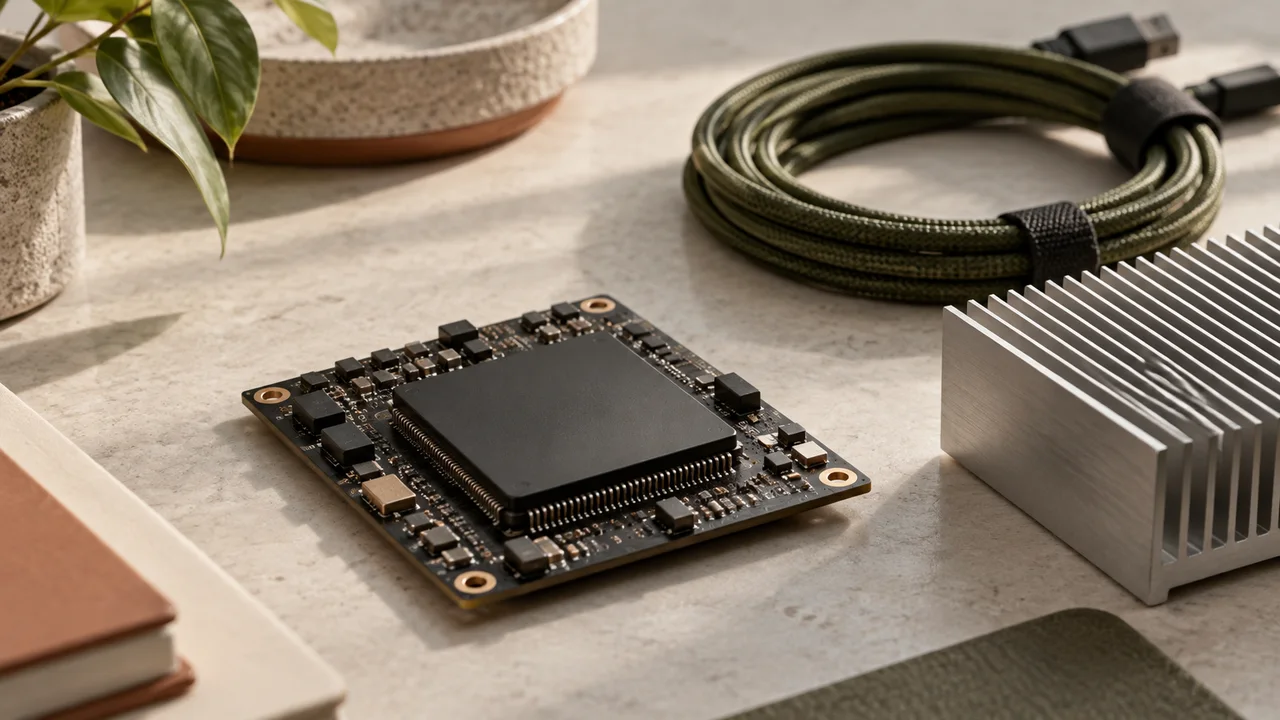
OpenAI has unveiled its first custom AI chip, built with Broadcom. The practical headline is not “OpenAI made silicon” in the abstract. The practical headline is that OpenAI is moving from being mainly a large buyer of GPU capacity to designing part of the compute layer that serves and trains its models. That changes the economics and operating envelope of future GPT systems, and developers will eventually feel it through API pricing, throughput, context windows, latency profiles, quota behavior, and model availability.
This is not an overnight replacement for Nvidia GPUs. It is not a guarantee that GPT-5.5 suddenly gets cheaper next week. Custom silicon takes time to deploy, tune, and integrate into production inference and training fleets. But it is a clear strategic move: OpenAI wants more control over the hardware bottleneck that defines modern AI products.
What OpenAI announced
OpenAI unveiled its first custom chip, built by Broadcom. The important facts are straightforward:
- OpenAI is designing custom AI silicon rather than relying only on merchant GPUs.
- Broadcom is the manufacturing and silicon partner behind the chip effort.
- The goal is to support OpenAI’s AI workloads at massive scale.
- The likely first impact is infrastructure economics and capacity planning, not a new developer-facing model feature by itself.
- This joins a broader industry pattern: major AI labs and cloud providers are increasingly building specialized accelerators because general-purpose GPU supply is expensive and constrained.
The announcement matters because OpenAI’s API business is compute-hungry in a way that traditional SaaS is not. Every autocomplete, agent step, tool call, embedding job, voice session, and long-context reasoning request burns accelerator time. If demand rises faster than available GPU supply, the API gets more expensive, rate limits get tighter, latency gets less predictable, or all three happen together.
Custom silicon is OpenAI’s attempt to bend that curve.
Why Broadcom is the interesting part
Broadcom is not a flashy consumer-AI brand, but it is deeply relevant here. The company has long experience in networking, ASICs, interconnects, and custom silicon programs for hyperscale customers. For AI infrastructure, the accelerator itself is only one piece of the system. The surrounding fabric matters almost as much.
In practice, large-scale AI serving is not just:
prompt -> model -> answerIt is closer to:
request router
  -> tokenizer
  -> KV cache lookup or allocation
  -> model shard placement
  -> accelerator scheduling
  -> interconnect transfer
  -> decoding loop
  -> safety / policy layer
  -> streaming response
  -> logging, billing, eval traces
The hard part is keeping all of that saturated without making individual requests wait too long.
Broadcom’s role suggests OpenAI is not merely thinking about “a chip” as a standalone accelerator. The real product is probably a system: compute, memory bandwidth, networking, packaging, and fleet-level scheduling designed around OpenAI’s actual workloads.
That distinction matters. A custom chip that is only fast on paper but awkward to schedule is not enough. A chip that is slightly less flexible than a GPU but much better tuned for transformer inference at OpenAI scale could be extremely valuable.
What developers should expect first
The first developer-visible impact is unlikely to be a new API parameter called use_custom_chip=true. Hardware improvements usually surface indirectly.
1. More stable capacity
When model demand spikes, developers notice it as:
- Higher latency during peak hours
- Shorter or stricter rate limits
- Queueing on large batch jobs
- Reduced availability of premium models
- More aggressive fallback behavior in multi-model systems
If OpenAI can add dedicated custom silicon capacity, it can smooth some of those spikes. That does not eliminate outages or throttling, but it gives OpenAI more room to shape supply around its own API demand rather than competing entirely in the external GPU market.
2. Better economics for high-volume inference
Inference is where custom silicon can pay off most visibly. Training frontier models remains brutally complex and often benefits from the flexibility of leading GPUs. Inference, especially at high volume, is more repetitive and therefore a better candidate for workload-specific optimization.
For developers, the long-term effect could be:
- Lower per-token costs on some GPT models
- Better discounts for batch or cached workloads
- Faster response times for common request shapes
- More generous context windows where memory economics allow it
I would not build a budget assuming immediate price drops. In practice, providers often use new efficiency to absorb demand, improve margins, and expand premium features before cutting prices. But over time, custom inference hardware creates more pricing room.
3. Model behavior may become more tiered
Custom silicon can push providers to separate model tiers more aggressively. Some models may run best on GPU fleets. Others may be distilled, compiled, quantized, or otherwise optimized for custom accelerators.
That means developers may see sharper differences between:
- Flagship reasoning models
- Fast general-purpose models
- Cheap batch models
- Long-context models
- Agent-specialized models
This already exists across today’s model market, but custom hardware makes the segmentation more deliberate.
The API cost math that makes this announcement matter
Let’s use a simple production workload.
Assume your app processes support tickets with an agent that reads customer history, retrieves docs, reasons over policy, and drafts a response.
Daily usage:
Requests per day:        100,000
Average input tokens:    3,000
Average output tokens:   500
Daily input tokens:      300,000,000
Daily output tokens:     50,000,000
Now compare two hypothetical price points:
| Scenario | Input price / 1M tokens | Output price / 1M tokens | Daily cost | Monthly cost |
|---|---|---|---|---|
| Premium model | $10 | $30 | $4,500 | ~$135,000 |
| Efficient model | $3 | $12 | $1,500 | ~$45,000 |
| Small fast model | $0.80 | $4 | $440 | ~$13,200 |
The math:
requests = 100_000
input_tokens = requests * 3_000
output_tokens = requests * 500

def daily_cost(input_price, output_price):
    return (input_tokens / 1_000_000) * input_price + \
           (output_tokens / 1_000_000) * output_price

print(daily_cost(10, 30))   # 4500.0
print(daily_cost(3, 12))    # 1500.0
print(daily_cost(0.8, 4))   # 440.0
A 2x infrastructure efficiency improvement does not automatically become a 2x API price cut. But even a 20–30% improvement matters at scale. At 350 million tokens per day, a 25% reduction on a $45,000 monthly workload saves more than $11,000 per month.
This is why custom silicon is not just corporate infrastructure news. It is product-margin news for anyone building on AI APIs.
How this compares to current model choices
The chip announcement is about OpenAI’s infrastructure, not a direct model benchmark. Still, developers choose APIs based on the intersection of model quality, latency, context, price, and operational dependability. Hardware strategy influences all five.
Here is how I would frame the current landscape.
| Model family | Practical strength | Common trade-off | Hardware implication |
|---|---|---|---|
| GPT-5.5 | Strong general reasoning, tool use, broad ecosystem fit | Premium usage can be expensive at scale | OpenAI custom silicon may improve capacity and inference economics over time |
| Claude Opus 4.8 | High-quality reasoning and writing-heavy workflows | Usually reserved for harder tasks due to cost/latency | Competes on quality; developers may route only complex calls here |
| Claude Sonnet 4.6 | Strong balance of intelligence, speed, and cost | Not always the cheapest for simple extraction | Often a default for production agents needing reliability |
| Claude Haiku 4.5 | Fast, economical, good for lightweight tasks | Less suitable for deep reasoning | Useful as a first-pass classifier or router |
| Fable 5 with 1M context | Very large-context workflows | Long-context requests can become expensive and slower | Memory and KV-cache economics dominate |
| Gemini 3 | Strong multimodal and Google ecosystem fit | Behavior and pricing vary by workload shape | Competitive for media-heavy and search-adjacent apps |
The key point: no single model wins every request.
In production, I rarely recommend sending every task to the most capable model. A better pattern is routing:
{
  "routing_policy": {
    "classification": "fast_small_model",
    "retrieval_answering": "balanced_model",
    "legal_or_financial_reasoning": "premium_reasoning_model",
    "long_context_review": "long_context_model",
    "fallback": ["primary_provider", "secondary_provider"]
  }
}
OpenAI’s custom chip could make GPT models more attractive in this routing table if it improves availability or price-performance. But Claude, Gemini, and long-context specialists like Fable 5 remain important because real systems need portfolio thinking, not vendor loyalty.
This is also where a multi-model access layer helps. AI Prime Tech, for example, can be useful when teams want cheaper access to Claude, GPT, and Gemini APIs without hard-wiring procurement and routing around a single provider. The business value is not only lower unit cost; it is the ability to compare models on your actual prompts.
What actually happens when hardware changes under an API
A common gotcha: developers assume API models are abstract services, so hardware changes should be invisible. They are mostly invisible, but not completely.
When providers migrate inference workloads to new accelerators, several things can shift.
Latency distribution changes
Average latency may improve while p95 latency behaves differently. For streaming responses, the most noticeable metrics are:
- Time to first token
- Tokens per second
- Tail latency under load
- Retry frequency
- Queueing during regional spikes
A model can feel faster even if total completion time only improves modestly, because the first token arrives sooner.
Batching behavior changes
Inference servers often batch requests together to improve accelerator utilization. New hardware can change optimal batch sizes. That may affect interactive apps differently from background jobs.
For example:
# Measure both first-token and full-response latency.
# Do not rely only on total request time.
for i in {1..50}; do
  curl -s -w "total=%{time_total}\n" \
    -H "Authorization: Bearer $API_KEY" \
    -H "Content-Type: application/json" \
    -d '{
      "model": "gpt-5.5",
      "messages": [{"role": "user", "content": "Summarize this ticket in 5 bullets."}],
      "stream": false
    }' \
    https://api.example.com/v1/chat/completions > /tmp/run_$i.json
done
In practice, I track latency by request class, not only by model. A 500-token summarization call and a 40,000-token document review stress the system differently.
Output determinism can still vary
Even if the model name stays the same, backend serving changes can expose small numerical differences. With temperature at zero, you should expect high consistency, not absolute bit-for-bit determinism forever.
If your application depends on exact phrasing, that is a design smell. Use schemas, validators, and tests.
{
  "type": "object",
  "required": ["category", "priority", "confidence"],
  "properties": {
    "category": {"type": "string"},
    "priority": {"type": "string", "enum": ["low", "medium", "high"]},
    "confidence": {"type": "number", "minimum": 0, "maximum": 1}
  }
}
The real developer opportunity: design for portability now
OpenAI’s chip does not mean “move everything to GPT.” It means the AI infrastructure market is becoming more specialized. The winning engineering move is to make your application portable enough to benefit from whichever provider has the best model, price, and capacity for each task.
Build a model routing layer
Even a simple routing layer is better than scattering provider calls across your codebase.
def choose_model(task, input_tokens, risk):
    if input_tokens > 500_000:
        return "fable-5-long-context"

    if risk == "high":
        return "claude-opus-4.8"

    if task in ["classify", "extract", "rewrite_short"]:
        return "claude-haiku-4.5"

    if task in ["agent_step", "code_review", "tool_use"]:
        return "gpt-5.5"

    return "claude-sonnet-4.6"
This is intentionally simple. The point is architectural: centralize the decision so you can change it when prices, latency, or model quality changes.
Store prompt and completion telemetry
You cannot optimize what you do not measure. At minimum, log:
- Model name and version alias
- Input and output token counts
- Latency and time to first token
- Retry count
- Tool-call count
- Cache hit rate
- User-visible success metric
Do not log sensitive raw prompts unless your compliance model allows it. Token counts and metadata are often enough for cost optimization.
Run monthly model bake-offs
Model rankings change. Pricing changes. Context windows change. Your prompts change too.
A practical evaluation set might include:
- 100 real anonymized support tickets
- 50 difficult escalation cases
- 30 long-context documents
- 20 adversarial or ambiguous prompts
- 20 tool-use workflows
Run them across GPT-5.5, Claude Sonnet 4.6, Claude Opus 4.8, Haiku 4.5, Gemini 3, and Fable 5 where relevant. Score on task success, not vibes.
Limitations and trade-offs
It is worth being precise about what this announcement does not prove.
First, custom silicon does not automatically mean better model quality. Model quality comes from architecture, training data, post-training, evaluation, tooling, and deployment discipline. Hardware enables scale and efficiency, but it is not intelligence by itself.
Second, custom chips can reduce flexibility. GPUs are popular partly because they support a broad software ecosystem. A custom accelerator has to earn its keep on specific workloads. If model architectures change dramatically, specialized silicon can age badly unless it was designed with enough headroom.
Third, capacity gains may be consumed by demand. If OpenAI lowers internal serving cost, it may use that efficiency to support more users, longer contexts, richer agents, or multimodal workloads rather than lowering prices immediately.
Fourth, developers still need multi-provider resilience. A custom chip does not eliminate API outages, policy changes, regional incidents, or quota constraints. If AI is core to your product, build fallbacks.
What I would do this quarter
If I were running an AI platform team consuming GPT, Claude, Gemini, and long-context models today, I would not rewrite my roadmap because of this chip announcement. I would make four targeted moves.
1. Separate model choice from business logic
Your application should ask for capabilities, not hard-coded model names.
response = llm.run(
    capability="high_accuracy_ticket_resolution",
    input=ticket_payload,
    max_output_tokens=800
)
Then let configuration map that capability to GPT-5.5, Claude Sonnet 4.6, or another model.
2. Add cost budgets per workflow
Do not manage only global API spend. Set budgets by workflow:
| Workflow | Monthly token budget | Preferred model | Fallback |
|---|---|---|---|
| Ticket classification | 2B tokens | Haiku 4.5 | Gemini 3 fast tier |
| Agent reasoning | 800M tokens | GPT-5.5 | Sonnet 4.6 |
| Executive summaries | 200M tokens | Sonnet 4.6 | GPT-5.5 |
| Long document review | 100M tokens | Fable 5 | Opus 4.8 for excerpts |
This makes it easier to respond when a provider changes pricing or capacity.
3. Test for latency shape, not just average
Track p50, p90, and p99. For interactive agents, p99 can dominate user trust. A beautiful average latency hides the one request that freezes the UI for 18 seconds.
4. Negotiate and route aggressively
If you are doing serious volume, list prices are only the start of the conversation. Use your telemetry to negotiate. Use platforms like AI Prime Tech when cheaper Claude, GPT, or Gemini access improves your economics without compromising governance. And keep a routing layer so savings are not trapped behind one vendor integration.
Practical takeaways
- OpenAI’s Broadcom-built custom chip is an infrastructure move with developer consequences: better capacity, possible price flexibility, and more optimized serving over time.
- Do not expect immediate API magic. Custom silicon takes time to deploy, and efficiency gains may first go into scale, reliability, and new features.
- GPT-5.5, Claude Opus 4.8, Sonnet 4.6, Haiku 4.5, Fable 5, and Gemini 3 should be treated as a portfolio, not a single leaderboard.
- The best engineering response is portability: centralized model routing, clean telemetry, schema validation, and regular evals on your own prompts.
- Watch latency distribution and cost per successful task, not only per-token price.
- If AI APIs are material to your product margin, hardware news is product news. The chip behind the endpoint can eventually change what you can afford to build.
One API key for Claude Opus 4.8, Sonnet 4.6, Haiku 4.5, Fable 5, plus GPT & Gemini — up to 80% off official pricing, pay-as-you-go.
Get Your API Key →